The Gulf of Guinea (GoG) region has growingly become the world’s hot spot for maritime piracy and armed robbery attacks despite the ongoing health crises and travel restrictions. The ongoing maritime insecurity situation which precedes the Covid-19 pandemic, was examined against the current economic and occupational challenges faced by the maritime community. These challenges include the implemented Covid-19 travel restrictions and the ongoing effort at implementing Africa Continental Free Trade Area (AfCFTA) agreement –a designed boost to Africa’s industrial campaign and Intra trade amongst African nations. The piracy risk concerns potential sustainable maritime investment, measured against the risk posed to a successful implementation of AfCFTA. The study examines the current security threat in West Africa towards identifying the most appropriate recommendations with an integrated approach to tackling maritime piracy. The insecurity problems that risk the safety of marine operations, property, life, and the environment; ought to be reduced —if not eliminated. The case study approach identifies and investigates current policies and practices regulating maritime security in the region. While the study finds the earlier rising trend of piracy and armed robbery as a measure of inadequacy in security and surveillance, it does acknowledge the enormous legal frameworks and current structures of regional and international corporations that are currently ongoing. The problem of insecurity influences insurance coverage which goes to the cost of shipping. It also alludes to the much recent downward trends of which contributing factors have generated conflicting views amongst industry experts and stakeholders. Piracy response has been reactionary rather than proactive in most instances, as attacks have continued in territorial and offshore areas well into 2021. A lack of effective collaborations will continue to lead to undesirable outcomes. Concerning its visible impact on AfCFTA implementation amid covid-19, there is limited data on the issue. The conclusion highlights efforts directed at furthering the understanding of the impact of covid-19 and maritime insecurity on the maritime trade.
Keywords —Gulf of Guinea;Maritime insecurity;Maritime Piracy;Shipping route;Africa Continental Free Trade Area
Share
Introduction
This paper is the first of a two-part study delving into the problems of maritime insecurity in West Africa amid and post Covid-19 pandemic. Maritime trade continues to expand across Africa following massive investment to aid the region’s economic expansion. This development is amidst the great optimism initiated by the African Continental Free Trade Area agreement (AfCFTA) – a hallmark project of the African Union (AU, 2021). Thus, there is great expectation for a rise in trading amongst African nations to be facilitated by the transport network infrastructure and transport services sector. Though a continent-wide road network infrastructure for cargo truck haulages and planned expansion exist, the current connective infrastructure is deemed inadequate. Henceforth, the efforts are focused on establishing a railway network between coastal and landlocked nations. Especially within sub-Sahara Africa; to expand on regional trading. Projects of this nature and magnitude- as an example, are ongoing in Ghana with a US$2bn investment (Oirere 2021), and Burkina Faso, among other West African nations (Burroughs 2021). There has also been a continuous effort in the decade at expanding seaport infrastructures in handling several tonnes of cargo with an efficient turnaround time (U.S. International Trade Commission (USITC) 2018). These infrastructural developments are streamlined under the need for connectivity and promote market access. The events are in tandem with the changing economic outlook of Africa, and slow gains made are along with improving political stability over national, regional and continent-wide democratic issues, however fragile. As demand for import and export continue to rise, maritime shipment continues to grow in shipping traffic and remain essential to the local economies of Africa (UNCTAD 2020a). However, the rising marine traffic associated with the growing demand for shipping situated within the Gulf of Guinea (GoG) has also cult the interest of groups whose single goal is demanding ransom after successfully carrying out an armed attack of ships on the high seas.
Though the Covid-19 came with various health risks, the various travel restrictions, critical call to maintain covid-19 social protocols such as limiting public gatherings to a few individuals at a time, The call to stay-at-home, public health mandate orders, the local (internal) and international border closures, as well as regional, state and city-wide lockdowns under the public health emergency acts for controlling the spread of the coronavirus (Sackey et al. 2021). The enforcement of the policy regulations indirectly initiated a rise in public surveillance of human activity as the framework for monitoring and controlling the spread of COVID across the globe. These measures, however, failed to deter pirates from continuing to engage in maritime crimes. Thus, activities of these criminal pirates within West Africa have continued to thrive as if they operated as consented stakeholders to trade in almost ‘freer and unregulated times’ in waters without national borders in West Africa.
Evidence on the contrary from news reports across various media channels; have suggested strong efforts are directed towards maritime security nationally and regionally. Howbeit, the activities of these pirates over the last couple of years in this decade are continuing to grow in sophistication. Accordingly, the reports indicated a rise in piracy and armed robbery over the first nine months of 2020 [International Seafarers’ Welfare and Assistance Network (ISWAN 2020); the International Chamber of Commerce International Maritime Bureau (ICCIMB 2020)]. These reports affirm the earlier claim made. They noted that the GoG region alone constituted a 40 per cent increase in the kidnappings reported compared with the same period in 2019. They also observed that armed pirates with guns and knives abducted bigger group sizes of seafarers at further distances off the West African coast. However, since 2018, not a single piracy incident had been reported around the Somalia coast. It was highlighted in a report that the last three of the thousands of hostages held captive in the region over the years were freed in August 2020 (since ship hijackings peaked in 2011) (ISWAN 2020). Regardless, the ICC IMB have never ceased to urge vessels to continue the implementation of the Best Management Practices (BMP5 measures) to guide passage in those areas. They also encourage the need for a stable naval presence in the region (ICCIMB 2020).
The impact of piracy on any economy, business or individuals cannot simply be overlooked because of the covid-19 health crises and its complementary economic woes. If for nothing at all, the recent stats by ICCIBM indicate that piracy increased with increasing human or travel restrictions due to the Covid-19 pandemic. In other words, these pirates did not consider the health crises a significant threat to their lives other than an economic incentive. Ordinarily, pirates are a source of danger (threat) to the lives of sailors (ISWAN, 2020), the ships and the associated cargo they so-target. These threats take the form of physical injuries, psychological traumas, ill-health and sometimes death due to resistance to the attacks and kidnappings for ransom.
In addition, there are many occasions where ships’ cargo (thus particularly oil) are stolen and sold on the ‘black market’. Such piracy incidences also tend to leave ship and ship assets badly damaged, which often require immediate repairs. The shipowners and their insurers expectedly bear the brunt of all costs associated with the pirate attack, with or without the support of flag states. In this case, Governments and nation-states from where these events occur tend to be branded negatively as ‘high risk’ trade zones. This negative outlook informs the high cost of shipment in and out of these areas, compared to other regions with safe shipping routes. Unfortunately, these pirate zones found are in maritime regions of developing countries whose combined gross domestic product (GDP) is relatively small compared to most nation-states in the developed economies. Therefore, every effort made must ensure total elimination or minimal incident occurrence now and post covid-19. This effort will ensure that continental intra-trading amongst African nations does not cost twice the price of commodity transport elsewhere due to associated risk to ships. Again, it will ensure that West African economies are well-positioned to maximize the benefits of the continental free trade zone created across the entire continent.
The study, therefore, examines the current maritime security threat in West Africa amidst the pandemic towards identifying the most appropriate recommendations with an integrated approach to tackling piracy. In doing so, the study will identify and investigate the current policy implementations and practices regulating maritime security in the sub-region. The study will also slightly examine the impact of the Covid-19 crisis on security, thus establishing the relationship for each’s impact on trade. Identifying and assessing the various measures implemented nationally and regionally will be carried out. These distinct outcomes and recommendations will help with promoting economic recovery for West African nations and lead to better maritime security preparation for future pandemics and any potential disruption in the global supply chain.
Review
2.1. An Overview of Africa’s Transport Sector to Economic Sustenance
According to UNCTAD (2020a), over the year 2019, Africa accounted for about 12per cent of the maritime transport trade volumes loaded in developing countries and 7per cent of the unloaded ones. This situation thus suggests there is more room for improvement with the appropriate structures such as policy and infrastructure needed to enable economic expansion. Kouassi (2018) affirms this assertion- noting that transport remains an essential enabler to trade and commodity cargo circulation. According to Kouassi (2018), the freight transport sector of Africa- as seen today, “faces several structural and organizational problems,” for which various efforts underway are aimed at developing integrated regional economies that harnesses maximum benefit from the global market.
Kouassi further suggests these projects are in line with the UN Sustainable Development Goals (SDG) and thus, therefore, benefit from the support of various international technical and financial partners. Nonetheless, according to UNCTAD (2020a), the declaration of the COVID-19 pandemic in March 2020 has negatively impacted Africa’s growth. Thus, within the second quarter of 2020, UNCTAD estimated a drop in Africa’s exports to -35 per cent. General imports also dropped by -25 per cent, though July saw some improvements. There were still double-digit drops of -17 per cent for imports and -21 per cent for exports. The data from UNCTAD further suggested -a drop in the number of ships calls in Sub-Saharan Africa at -9.7per cent, with the drop in container ship calls at -12.7per cent by late June 2020. They, however, suggested the impact was minimal for bulk shipping, with dry bulk carriers port calls declining by 7.7per cent to 1.4 per cent for wet bulk carriers. While ports in Africa showed mixed trends regarding the impact on connectivity according to UNCTAD, three ports, namely, port of Lagos, Durban, and TangerMed, were observed to have coped well with the pandemic relative to other ports in the region. Thus, regardless of blank sailings negatively impacted service frequency. Inland transportation subject to restriction resulted in challenges to cross-border crossings (UNCTAD 2020a). According to UNCTAD, Africa’s maritime transport sector needs to address its challenges in light of innovation and technology, infrastructure quality, regulation and governance, human capital and skills. That should also include business and investment –thus as it looks forward to capitalizing on the share market size of its member states trading amongst itself.
2.1.1 The Changing Dynamics in Connectivity of Africa’s Transport Sector
According to Burroughs (2021), Africa, the second-largest continent is with a long list of transport challenges and therefore suggested that it was relatively easier “to fly via a European capital than flying direct between African capitals.” Burroughs asserted- the cost of transport was also among the highest in the world. This situation directly reflects in the cost of trade–making products uncompetitive on the international markets. He cites as an example the cost of transporting a car from Japan to Abidjan at US$ 1500, inclusive of insurance costs. However, the cost for the same nature of operation across Africa from Addis Ababa to Abidjan -is quoted at US$ 5000 – three times higher in cost. Hence, it is said that total exports from Africa among neighbouring countries amounted to only 16.6per cent due to the many challenges associated with logistical support and trade barriers. According to Burroughs (2021), the current railway networks on the continent generally fall into one of the two categories, namely; (i)Railway lines were built during the colonial era. He asserts that many of these lines have deteriorated and are unusable. Others require substantial maintenance or upgrading and (ii)Standard Gauge Railways (SGR), are being built to help connect landlocked economies with coastal ports. This effort is to improve internal freight and passenger connections.
The challenge at improving infrastructure has been funding according to Burroughs (2021) who reiterated concerns of industry stakeholders while commending recent efforts at making funding available from China and Europe in particular. By far, data collated by CARI (China Africa Research Initiative) suggest an estimated $US 30.928bn of funds has been allocated to transport projects on the continent since 2013, with rail heavily featured (Burroughs 2021). Concerning maritime infrastructures, several projects have been completed while others are ongoing, especially along the west and central coast of Africa. In summary, as indicated by Burroughs (2021), among others, the poor road and railway network infrastructures along with lower volumes of tramp and liner shipment by sea as a result of higher port charges, among others; continue to serve as a disincentive to upscaling local interest within the maritime space for cross border trading in Africa. This situation has become compounded by the rising case numbers of piracy –a dynamic hastily shaping the insurance world and the cost of shipping in the region (Hellenic Shipping News Worldwide 2019).
2.1.2 The Role of Maritime Transport amidst Continental Integration
It is essential to note that the integration of the African continent currently remains above average for all the five major Regional Economic Communities (RECs), according to the African Union, AU (2020). The East African Community (EAC); Economic Community of West African States (ECOWAS); Common Market for Eastern and Southern Africa (COMESA); Economic Community of Central African States (ECCAS); and the Southern African Development Community (SADC) have demonstrated progressive efforts towards integration with scores above 0.6 over a rating range of 0 and 1. The other RECs, including the Intergovernmental Authority on Development (IGAD); Community of Sahel-Saharan States (CEN-SAD); and the Arab Maghreb Union (AMU) scored above the average of 0.5. With regards to poor performance by the three RECs, the AU further identified lack of defined plans or programmes in certain dimensions of integration such as free movement, financial and monetary integration as the cause.
According to the AU (2020), the 2021 African Integration Report shows that ECOWAS, COMESA and EAC performed satisfactorily in trade integration, with an overall score above 75%. The essential steps for achieving trade integration such as the free trade zones and a common external tariff, among others have been implemented by the three.
At the infrastructural level, the AU stated that all the RECs are at parallel and do corroborates the general problem of lack in infrastructure development in Africa, which does not effectively support the integration process. With an The AU affirm that no REC stood out significantly in terms of the achievements and progress made given the average progression rate was 63%.
Similarly, on the issue of “Free Movement of Persons at the centre of Continental Integration”, the AU found that the average progress of the RECs was moderate at 0.68 on the rating scale. However, ECOWAS and EAC stood out from the other RECs in the evaluations with respective ratings of ECOWAS (100%) and EAC (96%). All the other RECs score below 65%. The AU linked this poor performance to issues of immigration implementation protocols and the abolition of visas in their Member States (AU, 2020).
These efforts of Africa continental integration continue to remain essential component to economic development of Africa. This is in tandem with the trade integration of the continent on the maritime front as road and rail infrastructure still remains low on the continent. There is no doubt concerning the role seaborne trade plays in the economic development of Africa. According to Audigé (1995), 30-50 years back between 1970 and 1992, total goods loaded and unloaded in Africa averaged 9 per cent of the world’s seaports. The estimate represented over 85 per cent share volume in value of the continent’s trade. Audigé further alluded that demonstrated the importance of maritime transport for Africa. Consequently, West African countries’ share accounted for 30 per cent of all goods handled within African ports in 1992. He highlighted that of these volumes, 30 per cent share is constituted of crude oil and oil products, and 29 per cent share volume of dry goods.
The North, West and Southern Africa had comparable shares of 30 per cent each of total dry cargo. Therefore, Audigé (1995) suggest that competitive access to transport services for dry cargo remains equally important in all three regions. However, for West Africa, where the dominance is of crude oil and oil products traded, the maritime transport ought to be analysed separately in the deliberations on liner shipping. The 2020 UNCTAD review also affirms the trends in terms of average share volumes (loaded and unloaded goods) of trade at 9 per cent have risen slightly and continue to rise till today. Ali (2015) reiterated that the Gulf of Guinea remains the only developing region that registered six per cent as an average growth rate in 2010, with high-income gains of ten per cent to the Gross Domestic Product (GDP) of some States (World Bank 2011). He notes the growth was spared by favourable international trade hinged on the shipping industry as the primary vehicle. This envisaged growth in trade volumes accompanying infrastructural development in the maritime sector has become subject to rising concerns of maritime insecurity from the various news report.
2.2. Overview of the Issue of Maritime Insecurity
Maritime security and insecurity are used interchangeably in this review. In recent times, it is given broad definition as it draws attention to most newer challenges (e.g., cyber threats and terrorism). The interpretations also are on the nature of threats observed industry-wide and the needed support at tackling them. This newer threat vastly varies from the traditionally known threats defined under the United Nations Conference on the Law of the Sea (UNCLOS) 1982 convention. In other words, one can define maritime insecurity as implying the absence of security for property and life. This simple definition remains at the backdrop of the primary responsibility of national governments in ensuring general security for all its native citizens, no matter where they may find themselves. Hence, thus remain one of the reasons for the seeming difficulties associated with the term.
Maritime insecurity is, therefore, an offshoot of the term maritime security. Limo (2012) defined maritime security as “the absence of acts, which negatively impact the natural integrity and resilience of any navigable waterway. Such acts impact the maritime environment by undermining the safety of the operations in the seas and the security of persons conducting lawful transactions in international waters.” For this study, maritime insecurity is defined based on a modification to Limo’s definition and thus refer to all the acts that negatively impede the natural integrity of navigation, undermining the safety of operation and security of individuals engaged in lawful conduct in international waterways. This definition, like others, remains subjective and does add to the growing calls for a consented definition.
Henceforth, given the absence of international coordination on a definition of maritime insecurity, for that matter, maritime security for various socio-political reasons, Buegar (2015) proposed the three frameworks on which the potential definitions could be based. The first one -is grounded on the matrix of maritime security relationships subtended to other related concepts such as maritime safety, sea power, blue economy, and ocean resilience. The second framework refers to securitisation -thus allowing for the study of maritime threats observed and the wildly divergent political claims hosting the various ideological and political interests. The third framework reflects maritime security practice theories –allowing stakeholders to operate on claims of enhancing maritime security. According to Buegar (2015), integrating these frameworks should help with maritime security mapping.
Buegar’s proposal; was drawn on the back of efforts that have driven various international debates at given maritime security meaning in action. Some of these efforts included the North Atlantic Treaty Organization (NATO)’s action plans, which included maritime security as one of its objectives in the 2011 Alliance Maritime Strategy (AMS) pioneered by the United States of America (USA) through its national Maritime Security Policy 2004. Subsequently, with growing international efforts, 2014 also saw the African Union, together with the United Kingdom and the European Union, develop an ambitious maritime strategy (2050 AIM STRATEGY). In addition, maritime security has also been included on the list of tasks of the International Maritime Organisation (IMO) Maritime Safety Committee (Murphy 2010; Beugar 2015). Therefore, there is a clear consensus from all the various deliberations that maritime security refers to different threats (such as cyber threats, terrorism, piracy, robbery, illicit trade, and contraband goods) for different governments and regions. However, there are some commonalities in the various threat they each face.
2.2.1 Current Trends in Traditional Maritime Crimes
Focusing on the traditional threats of piracy and armed robbery on the rise across the developing world, especially the West African sub-region, the ICCIBM continuously receive information on attacks and aid in their responses. They do compile these data set while analysing them for current trends. The ICC IBM’s work continues to benefit from its creation, the Piracy Reporting Centre (PRC), commissioned in October 1992. According to their reports, 2020 recorded 195 global maritime piracy and armed robbery incidences between January and December though these incidents were reported averagely lately (ICCIBM 2020). The statistics highlighted South East (SE) Asia and the Americas, with 31.63 per cent and 15.38 per cent, respectively, as with growing maritime security problems next to Africa. Thirteen (13) African countries contributed to 45 per cent of the overall attacks recorded. Benin, Nigeria, Indonesia and the Singapore Strait contributed to 49 per cent of the attacks reported compared to 45 per cent the previous year (ICC IBM 2020). It was also noted that kidnappings at sea growingly endangered the lives of over 400,000 seafarers. This estimate alludes to the grave extent and severity of attacks within the GoG –threatening global trade and safety of ship manning operations, according to the IMO (Support 2021).
The GoG bounded by twelve countries had ten recordings, representing 54.36 per cent of total attacks for the year 2020, highlighting the challenges faced by the maritime industry of the sub-region (ICCIBM 2020; 2021; 2022). In spite of that, on any day of the year, there are over 1,500 marine vessels operational in the waters of the Gulf area. That includes fishing vessels, wet bulk carriers (tankers), general and breakbulk cargo carriers -navigating. Others are container ships. This vessel traffic suggests high usage of the sea area for various economic reasons. However, the concerns of piracy, armed robbery at sea, kidnapping of seafarers, illegal fishing, smuggling and trafficking, and transnational organised crime pose a major threat to maritime security in the GoG ultimately to the economic development of the entire region. For 2018, the region experienced nearly a 50 per cent increase in kidnappings for ransom, which rose roughly by 10per cent in 2019 (ICCIBM 2020; GM Event (IMDEC) 2021). Ironically, the various covid-19 restrictions and the health crises generally appear to have had no impact on the rising trend of pirate attacks globally compared to other global challenges such as global warming and climate change affecting the world. Several scientists have suggested the pandemic had consistently led to drops in global carbon emissions over 2020 (Le Quere et al. 2020). There are also legal efforts taking place to help deal with the piracy menace, according to the United Nations Office on Drugs and Crime (UNODC) Global Maritime Crime Programme (2020). Several pieces of training, including the 3-day mock trial of legal experts in Ghana, intended to help with judicial adjudication of culprits involved in high sea piracy and armed robbery upon apprehension. There are also signs of lack of interest in collaboration amongst some actors observed in the region.
2.2.1.1 Piracy Downwards Trend, Issues of Mistrust, False Reporting, and Collaboration
Although in 2022 GoG piracy and armed robbery statistics as per ICCIBM (2021; 2022) suggest a continuous downward trend, there are questions about what primarily contributed to the phenomena. Two schools of thought continue to debate the impact of international naval presence as opposed to regional navies. There is no doubt that the regional navies continue to play the role of the first line of security in the maritime environment of their various nations; many believe their effort is insufficient and might have led to the rise in piracy and armed robbery cases on the high seas within GoG over the last decade. Some experts and stakeholders including the EU and IMO still believe the role of regional navies remains crucial in the fight against piracy, and direct engagement with international partners is fundamental to any progress (Dryad Global, 2021; IMO 2023; AfricaIntelligence.com 2022). However, other experts and stakeholders barely credit these regional partners for the progress made with security in the GoG area when highlighting the efforts of the international partners. These experts and stakeholders suggest that the current downward trend is wholly a result of the presence and actions of international navies. Thus, the ICS attributed the successful downward trend to international engagement while citing the anti-piracy interventions of the Danish deployment of Esbern Snare as an example. Others, such as BIMCO (2022), have called for more of these pressures brought to bear by these international navies.
On another breath, some international stakeholder institutions, such as BIMCO, have downplayed the downward trend as temporary and associated efforts of some regional partners as geopolitical expedience. According to BIMCO (2022), “some speculate that the pirates are perhaps paid to lay low during the period up to the presidential election” in Nigeria. These results suggest some level of mistrust for regional institutions among international stakeholder institutions.
2.2.1.2 Issues of Mistrust, and False Reporting
The evidence of mistrust fuelling these speculations is observed in the disagreement between the Nigerian authorities and the Danish navy following the Esbern Snare incident (2021), which was not prosecutable. There appears to be some level of mistrust of regional actors. Again, in the recent arrest of the Heroic Idun by the Equatorial Guinea navy following the request by the Nigerian navy under the Yaoundé protocol, international stakeholders were quick to back the false flag alert sent by the ship during the pursuit, as supported in the statement of the ship’s management. Although this is a developing story, others have condemned (Lloyd’s List, 2022) the narrative of the Nigerian authorities even as the case is being considered at the ITLOS.
From these incidences, it is unclear what evidence these international partners and stakeholders examined to make this claim; however, both assertions made by these international bodies seemingly cast doubt on progress on the issue of effective collaboration with external partners and the extent of contribution by regional efforts.
The other school of thought, including Okafor-Yarwood, views the recent interventions in the region by international partners as unilateral from conception through to execution and thus only resorting to regional support at the late stage when they had no option but to do so. She decried this lack of collaboration as counterproductive (2022a). According to Okafor-Yarwood, the Esbern Snare (2021) incident and its aftermath exemplified how some international actors (navies) in the region acted with no regard for the need to include regional actors at the early stage of collaborative interventions.
2.2.1.3 Issues of False Reporting and Impact on Collaboration
On the issue of false reporting, thus specifically of the false piracy alert by the Heroic Idun published by ICC IBM, some experts have raised concerns about verifying the accuracy of reporting before broadcasting incidents. Okafor-Yarwood (2022a) posited that the Heroic Idun incident false broadcast belonged on “the must be forgotten and not repeated’ list.” She exclaimed that we “take the lessons and run, and stop with this romanticization,” given the fallout from that event. She made this claim as a result of commentary run by international stakeholders inclined to believe the ship’s recount of the event as opposed to the Nigerian authority. Such false reporting compromises the regional efforts in the war against piracy and feeds into the mistrust of these bodies. It remains unclear whether the false piracy claim made by the ship crew was made out of corrupt intent or was a genuine mistake that investigations of the facts following the International Tribunal for the Law of the Sea (ITLOS) filing should subsequently reveal.
While the ensuing disagreement between the regional authorities and the ship’s management has cultivated wider international interest, Okafor-Yarwood cited the OSM Maritime Group statement concerning the incident (Marine & Petroleum Nigeria, 2022) as one that was deeply troubling. According to the OSM (2022) narrative, “The Nigerian navy approached the vessel under cover of darkness in a way that caused serious concerns, and it was believed to be an attempted piracy attack. The vessel, following Best Management Practice, escaped from the area and out into international waters.”
The OSM statement is countered by the Nigeria navy (DINFO, 2022) fact sheet shared on Google Docs. Okafor-Yarwood (2022b), among others, notes that the statement by OSM did not dissociate itself from the false piracy alarm and raised concerns as to why the ICC International Maritime Bureau broadcasted the false alarm without confirming the incident with regional agencies.
“We need to talk about what seems to be a lack of engagement with regional agencies like the ICC in Yaoundé and the MMCCs. When an incident is reported (real or fake), you don’t confirm with local agencies, yet they are supposed to be the focal point. What is the essence of having local agencies if outside entities continue to work as though they are not there?” (Okafor-Yarwood, 2022b) From the thrust of the arguments, the lack of circumspection by international partners in their public commentary is linked to mistrust, and plain disregard for regional authorities will continue to hamper the effective collaborations desired. In a related development, Okafor-Yarwood (2022c) further indicated that by Order of the President of the Tribunal, Judge Albert Hoffmann, in the M/T “Heroic Idun” Case (Marshall Islands v. Equatorial Guinea), Prompt Release, was removed from the Tribunal’s list of cases’ –citing ITLOS. According to the letter released by ITLOS (2022), “Equatorial Guinea caused the Vessel and her crew to be transferred into the jurisdiction, control, and custody of Nigeria on 11 November 2022,” in line with the Yaoundé protocol. The legal case remains active though discontinued at the ITLOS.
2.2.1.4 Issues of Collaboration
On the issue of ineffective collaboration, some experts believe it is a result of the contribution of regional partners not being properly recognised by international stakeholders, largely due to inaccuracy in reporting. This is exemplified in the piracy case of the Panamax bulk carrier. Thus, while experts have commended the Italian frigate (Rizzo) for ‘averting’ the attack on ‘a Panamax bulk carrier,’ according to Okafor-Yarwood, these international stakeholders did so without recognising the role of other actors such as MMCC zone F (and MDAT-GOG).
Okafor-Yarwood (2022) also alluded that they missed out on the part that there was no evidence of a skiff in a radius of 70 nm. Okafor-Yarwood commended the work done by the Italian frigate (Rizzo) and emphasised that “accurate reporting goes a long way in painting a transparent picture and highlighting the importance of collaboration”.
In summary, despite the continuous call for effective collaboration in the region, there appears to be poor coordination tied to concerns of mistrust of regional authorities. International examples, such as BIMCO, have suggested some form of geopolitical corruption, especially within Nigeria, given the upcoming election. Some have cited the award of a security contract for pipeline protection to ex-militia grouping as an example of a ‘conflict of interest’ and regional bodies acting in bad faith to temporarily reduce the incident of piracy for political expediency. Others, such as Lloyd’s List have used strong language referring to the regional authorities as being rogue “authoritarian” in the Heroic Idun case. This perceptive characterisation (character assassination) delegitimises the authority of these coastal states (Loyd’s List 2022). It thus may be the reason why some foreign actors took action within the GoG area with little to no interest in seeking regional collaborations, consequently leading to unpleasant outcomes. The posture depicts the attitude observed during the piracy crises in the Gulf of Aden (GoA), where no regional authorities were present due to political instability (Mair 2011; Shortland, 2013). Unlike GoA, the GoG countries are not failed states. Therefore, the current evidence also suggests a gross disregard for regional authorities in the region, which are futile and retrogressive. This is seen in the failed legal prosecutions and the seeming lack of corporation in the aftermath. The argument above underpins the conflict currently associated with the nature of the relationship between some of the regional actors and some of their foreign counterparts. This impasse may be a sign of a major problem if not immediately addressed for the region still undergoing development.
2.3. Importance of Maritime Security to Developing Economies and Trade
The GoG today serves the two major economic blocks of the West and Central Africa region, namely the Economic Community of West African States (ECOWAS with the fourteen membership countries) and the Central African Economic and Monetary Community (CEMAC with five membership states) despite the growing maritime insecurity. The Nigerian Navy alone in 2020 reported 339 (out of which 214 armed robberies) incidents of piracy in the region (Institute of Security Studies, ISS 2021), where a population of 3 million people directly or indirectly are employed within the fishing industry. The region’s economic value as a food source cannot be overemphasised, given that the native populations rely on fish protein averaging 20kg annually per capita consumption (2kg higher) compared to the world average of 18kg. Fish catch of the region is estimated at 1.6 million tons of catch per year (about $3 billion) with a $1.5 billion worth of lost value in fishing revenue due to IUU (Wiafe, et al. 2017; www. reuters.com 2012). Mañe (2005) contributing to the International Monetary Fund (IMF) working paper about the resources, suggested over a decade and a half that the Gulf of Guinea’s region had enormous economic potential capable of creating huge investment opportunities for the region’s inhabitants besides the fishing trade as a food source. Thus, with resources, such as oil, minerals, and forests that continue to attract significant investments, others such as natural gas; could be exploited at their fullest potential. This assertion remains true today. However, it remains unclear to what extent this potential has been realised in terms of local and foreign direct investments. With a market size of 300 million consumers generating a GDP of $112 billion, about $45.5 billion are exports of raw materials while imports account for $31.63 billion (International Monetary Fund, IMF 2005). Economies of the region have continued to expand since 2004 despite the 2008 recession. The cost of transporting goods within the region is continually on the rise with rising port charges and the cost of shipping in general. Some of the factors associated with the rising cost include the cost of insurance premium cover, particularly kidnap and ransom (K&R) cover. According to Steamship Insurance Management Services Limited (2015), the ship mutual clubs now offer its members cover for Hull War and P&I War risks and cover for piracy, and Kidnap & Ransom (K&R). These covers complement the Members’ mutual P&I entries and provide streamlined service in a piracy, seizure, or war event. The growing maritime insecurity has also led to the expansion of the K&R insurance to encompass ‘Cyber Extortion’ risks, thus protecting Members from the effects of ransomware attacks. Such cost, according to Steamship Insurance Management Services Limited (2015), typically covers: • Up to US$10 million per insured event • Loss of ransom in transit - up to US$10 million per insured event • Fees and expenses of consultants - unlimited per insured event • Additional expenses, including but not limited to: • Fees and expenses of independent negotiator • Fees and expenses of independent public relations consultant and/or interpreter • Travel costs • Crew wages • Interest on loans raised to pay the ransom • Fees and expenses of security guards to protect crew after an insured event • Cost of getting the ransom to the kidnappers • Cyber Extortion extension cover ransom, expert fees and the costs of restoring data arising from a ransomware attack. However, limits up to US$1 million are available.
Despite the rising cost of shipping and trade, there are great calls on the continent of Africa today to ensure value addition before exports of goods to the markets of the developed world. However, these calls have been met with heavy opposition from the international investor communities. A case in point is the recent notification given by the president of Ghana, Nana Akufo Addo Dankwa; concerning the decision to gradually end the export of raw cocoa beans (used for chocolate manufacturing) and only export high-quality finished cocoa products –as the leading world producer of cocoa (Citi newsroom, CNR 2021).
Again, the financial impact of from Covid-19, as has been alluded to, of the potential drop of US$700 billion regarding external private finance inflows into developing economies in 2020 compared to 2019 levels that exceed the immediate impact of the 2008 Global Financial Crisis by 60% (Organisation for Economic Co-operation and Development, the OECD 2020). Speaking on a separate occasion at the United Nations (UN) summit, the president of Ghana indicated that Africa is working on harnessing local resources while attempting to deploy them creatively and efficiently possible to aid in financing the rapid economic and social transformation needed. He called on Africa to make every effort at generating the additional funds locally for this advancement with the support of international partners (UN 2020). These comments came on the back of the launch of AfCTA, which is intended at strengthening economic trading ties among African nations –with the AfCTA secretariat sited in Accra, Ghana.
2.2.3. Promoting Investor Security and Good Governance
Investor security and good governance can be some of the concerns that have limited Africa’s growth over the years. Political instability across large portions of the region continues to serve as a disincentive to local and foreign investors (Ong’ayo 2008). However, with the potential expansion in trade in Africa, African investors living within relatively unstable regions may capitalize on the stability of regions in the economic zone to relocate businesses with ease (The Maritime Executive 2021a).
This situation may leave regions or nations plagued with insecurity in dire financial woes, but it also serves as a disincentive for such leading actors from continuing in their current course of action. They are therefore encouraged into choosing the path of good governance. Moreover, such investments ensure employment and growth of the economy and help reduce or eliminate poverty in poor communities such as those of most coastal fishing communities in Africa (Okafor-Yarwood et al. 2021).
2.4. Current Practices and Regulations against Maritime Insecurity
Due to the expanse nature of the high seas and the usually unrestrained jurisdiction with which the crime of maritime piracy and armed robbery occurs, multilateral cooperation is encouraged at dealing with the menace under various institutionalized frameworks (European Union (2021) as cited PR Newswire (New York) 2021). Besides Article 101 of UNCLOS 82, and the IMO Resolution A.1025 (26) (as in Annex, paragraph 2.2), several international and local efforts have led to various regulations, policies, strategies and collaborations at various levels to help promote maritime security across the world’s oceans.
The EU Maritime Security Strategy Action Plan and the EU GoG Strategy and Action Plan (adopted in 2014) form the EU’s response to these challenges in the region and the current offshore and shore facilities. Thus, they help raise awareness and understanding of the threat, strengthen cooperation and promote more prosperous and resilient coastal economies and communities. The Critical Maritime Routes Monitoring, Support and Evaluation Mechanism (CRIMSON) was implemented with an overarching €2 million, which encompassed the 2016 launch of GoG Inter-Regional Network (GoGIN), the 2019 support to West Africa Integrated Maritime Security (SWAIMS), the support to Programme to the Maritime Security Strategy in Central Africa (PASSMAR), improved regional fisheries governance in western Africa (PESCAO), improvement of Ports’ Customs and Operations Efficiency in African ports (IPCOEA), among others (European Union (2021) as cited by PR Newswire (2021) Regional cooperation of ECOWAS and Economic Community of Central African States (ECCAS) also ensures that Interpol and UNODC’s Global Maritime Crime Programme are engaged where needed, and cooperate with G7++ Friends of the GoG (G7++ FOGG) on maritime security agenda. June 2013 also saw the GoG governments sign the Yaoundé Code of Conduct concerning the need to repress piracy, armed robbery against ships while promoting maritime activities in West and Central Africa. Thus, it is evident that efforts directed against maritime insecurity today are witnessed on all forms of cooperation at different levels and with varying strategies. However, there is much to be desired of the current state of affairs of the GoG shipping trade route. This is because the spike in maritime insecurity concerns; got worsened over this last decade.
According to Okafor-Yarwood et al. (2021), policies and strategies must ensure safety to seafarers’ inshore and offshore while dealing with threats to the natural environment (fisheries crime) marine pollution) and livelihoods of the littoral communities. They suggested that sustainable security solutions within the Guinea GoG would not be complete without the improved socio-economic well-being of coastal communities vulnerable to organised criminal networks. Therefore, they further highlight that rushed responses in reaction to sensationalized news reportage of pirate or armed robbery attacks at sea; could inure to the benefit of shipping companies at the expense of the states involved. In the long run, they could exacerbate situations focused on the symptoms rather than the root causes.
As alluded to by Okafor-Yarwood et al., the nature of crimes observed in the region goes beyond pirate attacks and armed robbery. Thus, some of the crimes observed are against the natural environment such as illegal fishing, for which several policy framework and direction has been implemented by the various national governments. Some of these illegal fishing operations include the use of per trawling, lighting fishing, unapproved fishing nets among others, which affect the breeding of fingerlings. There is also the issue of overfishing as a result of continuous large scale commercial fishing all year round. These crimes are committed by both artisanal fishing boat (LFBs) operators and commercial grade power-driven fishing vessels. While there appears to be an immediate upside to illegal fishing for all engaged in the practice, there is growing evidence of depleting fish stock which is affecting the livelihood of people within these coastal communities. It is essential to note here that as a result of fishery crimes, and the desire to resolve the problem of overfishing, ‘close seasons’ are implemented across EEZs in the region (Ghana News Agency, 2021; STOP ILLEGAL FISHING, 2019) to rebuild targeted the small pelagic marine fisheries stocks by adopting sustainable fishing practices (Yamoah 2018). The enforcement of the close seasons for instance in Ghana has been challenging for the various segments of the stakeholder populations, especially of the artisanal fisherfolks (Adogla-Bessa, 2019). Having the naval and police patrols actively engaged in surveillance and monitoring, there is still the challenge of the extent of coverage for monitoring power-driven fishing vessels in the region compared to LFBs.
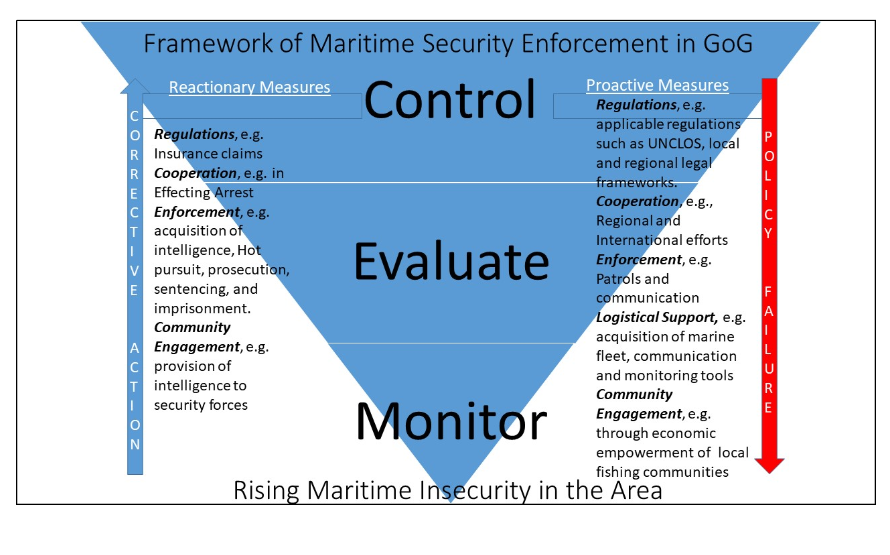
To Okafor-Yarwood et al., economic grievances among marginalised coastal communities keep the locals in a cycle of deprivation that exposes them to crime (Okafor-Yarwood et al. 2021). All these measures identified do contribute to efforts that are either viewed as reactionary, or proactive in the fight against maritime insecurity. These measures are summarized into the conceptual framework seen in Figure 1.
Figure 1: Pyramid of Current Maritime Security Enforcement in West Africa. Source: Conceptual Model Developed based on Compilation of Existing Literature
2.4.1 Challenges to Effective Implementation of Maritime Security Measures against Piracy
The recent rise in maritime insecurity in the GoG area affirms the general claim of inadequacy, thus, in measures taken to curb the trend. As has been alluded to in previous sections, various measures and efforts continually are put in place to ensure maritime piracy and robbery -are wholly eliminated. Among some notable measures include various adopted regulations, international and regional cooperation in military drills, training and workshops against enforcement and regulations. There is also the benefit of technology transfer, such as in the acquisition of a marine fleet. Thus, to aid with patrols and enforcement of regulations. Other efforts include the expansion of legal prosecutions of cross-border piracy and armed robbery culprits (The Maritime Executive 2021b; Ian Ralby 2021) in West Africa. This prosecution effort was possible with support in legal training capacity building given to some select members of the judiciary service across the region. The successful prosecution of the nine pirates is the first of its kind in the region (The Maritime Executive 2021b). These efforts complement the enforcement and regulatory process which are part of the reactionary measures to the menace (see Figure 1). While the recent successful prosecution of arrested pirates in itself, has been hailed as a major breakthrough in the piracy fight in West Africa (Ian Ralby 2021), it does serve as a deterrent measure. It also goes to minimize the potential for advancing the experiences accrued by such individuals that have the potential of making them more efficient in their operations while offering such expertise to vulnerable individuals in deprived coastal communities as newer pirate recruits per observations made by Okafor-Yarwood et al. (2021).
Summary and Discussion
This section of the two-part study recognises that the GoG region is a very critical resource to the socio-economic development of the countries of West Africa. Arguably, the region has seen and continue to see maritime trade expansion on the heels of massive infrastructure development in recent decades ushering in the African Continental Free Trade Area agreement (AfCFTA). Howbeit would increasingly become a mirage of its intended glory if the trend of maritime insecurity is allowed to persist. With Africa accounting for 12 per cent and 7 per cent of the maritime transport trade volumes loaded and unloaded within developing countries in the year 2019, highlights the premium placed of trade in the regional maritime transport sector along with the supply chain network.
UNCTAD, therefore, highlights that Africa’s maritime transport sector needed to address its challenges including maritime insecurities that recognises the changing dynamics in the local, national and regional connectivity needs of the entire continent amid the continent-wide intra-trade expansion. The study proceeds to define the term maritime insecurity as to “refer to all the acts that negatively impede the natural integrity of navigation, undermining the safety of operation and security of individuals engaged in lawful conduct in international waterways,” which is based on Limo’s definition of maritime security since there is currently no standardized definition in the industry.
While the nature of the maritime threat has evolved over the years, the GoG region with over 1500 vessels in regular daily operations, has become a hotspot for traditional maritime crimes of piracy and armed robbery according to various data from the ICC IBM. The year 2020 alone saw 10 nations in the region record 54.36 per cent of the entire crime observed across the world— highlighting the urgency of the threat to the socio-economic and political stability of the region.
Hence, the importance and urgency for maritime security cannot be overemphasised since the rippling effect of these challenges are seen in terms of rising commodity pricing amongst others which are consequential to the cost of insurance premium cover, particularly kidnap and ransom (K&R). Essentially, the cost of piracy in the region has been subjective. In Nigeria, the cost in the year 2020 was determined to be over $1.1 billion. It is also reported that average ransoms per crew member were capped at US$50,000, however, data on estimated economic cost within the GoG region is described as insufficient and thus, the study highlights the need as all Africans earnestly look forward to the many economic opportunities from AfCFTA – the continent-wide free-trade zone promises.
The study recognises herewith that various regulatory and policy strategies are implemented as efforts to curb the menace rumps up. Notable among these policy strategies include local, regional and international collaborations in terms of effort in capacity building, funding and technological support. Regional and international cooperation has also been on the front of devising and enforcing legislative instruments under the Yaoundé Code of Conduct for example. The study also reiterates the call for national governments to promote the socio-economic wellbeing of their citizens within vulnerable communities to serve as a disincentive for the unemployed seeking to join criminal syndicates. The mare rise in maritime crimes in the GoG area is a simple indication that the approach taken over the last decade to redress the problem is either insufficient and, or more needs to be done. The study recognises the first-ever maritime crime prosecution in the region against enforcement. This is a piece of welcoming news that goes to serve as a deterrent. While maritime crime in the region are not only limited to the traditional crimes of piracy and theft, growingly, policy interventions have also focused on the crimes and malpractices in the fishing industry that are believed to be the reason for the depleting fishing stock in the region.
According to Ralby (2021), a thorough analysis of the operational data from fishing vessels within the GoG region projects situations of potential illegalities in terms of use of vessel name, Automatic Identification System (AIS), IMO numbers, Mobile Maritime Service Identity (MMSI) numbers per SOLAS regulations. He sort to draw a link between the potentially illegal activities of some of the vessels operating in the region and the pirate attacks when examining the incidence of a recapture of the pirated Chinese fishing vessel (F/V) Hai Lu Feng 11 on 16 May 2020 reported (Ralby 2021). He posited that as evidenced in the 24 June 2020 pirate attack off the coast of Benin against F/V Panofi Frontier. The vessel was Ghanaian-flagged, with six crew members—one Ghanaian and five South Korean—taken hostage. According to him, apparently, the interdiction of pirates a month prior failed to serve as a deterrent (Ralby 2021). Arguably, though is it unclear as to reasons why SOLAS regulations were flouted by the fishing vessels, he highlighted the constraints of the illegalities as reasonable grounds –motivating the daring zeal of pirates in the region, and serving as a perpetual challenge to ocean governance. Therefore, for effective ocean governance to occur in the region, these concerns ought to be addressed, Ralby (2021) noted.
Since activities of the pirated fishing vessel prior to the incident raised more questions of illegal practices in the region, it thus reiterates the region’s current battle against depleted pelagic fishing stocks. This suggests that illegality may potentially relate to fishing crimes such as ‘fishing dark’ within close seasons in areas where there is less surveillance. The challenge is, to what extent are surveillance of protected areas (PAs) during close seasons carried out? Are these PAs zoned and properly marked out across the EEZ of the GoG regions across all the countries? Are these close season periods harmonized in a way to ensure efficient monitoring? Thus, for instance, of close seasons in Benin, Togo, Ivory Coast, and Ghana, how are they sync to allow for coordinated naval enforcement to be more regional in nature against illegal fishing rather than following picketed approach by individual states (Sackey 2021) ?
Conclusion
This part of the study recognises the threat maritime insecurity is playing in the West African sub-region in terms of promoting safety and stability in maritime trade which sits at the core of the complex global supply chain network. Given that not much is known in terms of the security, safety, health and economic cost these maritime insecurities have on the region and the entire world, the study reaffirms its objectives leading to the examination of the current maritime security threat to identify the most appropriate recommendations to an integrated approach in tackling maritime piracy.
Again, it is clear there are adequate laws for enforcement but the challenge is with adequate enforcement, whether through surveillance and monitoring or penalising culprits. If a fishing vessel can turn of AIS to go dark, it clearly tells the same can be done of any hijacked vessel intended to be used in pirate attacks hiding within the vast ocean space of the South Atlantic.
Though Ghana has a vessel traffic management system (VTMIS) implemented over its waters (Lamptey and Sackey, 2017), it remains unclear to what extent is it being used to segregate vessels operational in the waters against monitoring vessels exercising the right of innocent passage. Revelations from Ralby (2021) reiterates the need for a hard focus given to monitoring all fishing vessels. On another breath, inaccurate reporting and lack of trust appear to hinder the desired level of cooperation and collaboration between international and regional actors. This may have a chain effect on the individual efforts placed on the GoG area. It is unclear whether the issues leading to mistrust of regional bodies are well founded. This concerns needs to be addressed.
In furthering the understanding of the other objectives associated with those identified in the introductory section of the study, a continuation in the second of the two-part paper is here referred to. Thus, it is focused on evaluating the relationship of maritime insecurity amid Covid-19 on trade that identifies the maritime insecurity problems directly risking the safety of operations, property, life, and the environment. Rhetorically, how does this threat reflect in terms of financial cost on the local economies of West Africa on a global scale? These and many more queries are addressed in the second of this two-part paper titled, “Delineating the Relationship between Maritime Insecurity and Covid-19 Pandemic on Trade,” published in Journal of Shipping and Trade, Springer Nature.
Funding and conflicts of interest
Authors do note here that their judgment may or may not have been impaired by their affiliations with the study. However, on behalf of all authors, the corresponding author wishes to state that at no stage did the study receive any financial support in that regard.
References
African Union, 2020. Milestones achieved in the continental integration agenda; latest African Integration Report show, press release retrieved 14 March 2023, https://au.int/en/pressreleases/20220317/milestones-achieved-continental-integration-agenda-latest-african-integration
Adogla-Bessa, D 2019, Anloga fisherfolk complain over closed season on sea, lagoons, Online news Article viewed 01 December 2022, https://citinewsroom.com/2019/05/anloga-fisherfolk-complain-over-closed-season-on-sea-lagoons/
Africaintelligence.com 2022, EU wants four African navies to fight piracy together, news article viewed 02 January 2023 https://www.africaintelligence.com/west-africa/2022/06/29/eu-wants-four-african-navies-to-fight-piracy-together,109795769-art
African Union, AU 2021, About, Webpage material on Africa’s free trade area viewed 23 August 2022, https://au.int/en/cfta
Ali, K 2015, Maritime Security Cooperation in the Gulf of Guinea, Publications on Ocean Development, Volume 79. Ch (9), 1–9. https://doi.org/10.1163/9789004301047_002
Audigé M 1995, Maritime Transport Serving West and Central African Countries: Trends and Issues, https://www.ssatp.org/sites/ssatp/files/publication/SSATPWP16.pdf
Bielby, K 2022, Counter-Piracy Efforts in the Gulf of Guinea Pay Dividends, https://www.hstoday.us/subject-matter-areas/maritime-security/counter-piracy-efforts-in-the-gulf-of-guinea-pay-dividends/
BIMCO 2022, Insight and Information: safety, security and environment, Webinar material from https://www.bimco.org/insights-and-information/safety-security-environment/20220914-1515-nigeria-sev
Buegar C 2015, What is Maritime Security?, Marine Policy, Volume 53, 159-164, ISSN 0308-597X, https://doi.org/10.1016/j.marpol.2014.12.005
Burroughs D 2021, Africa's rail sector is poised for growth, viewed 21 December 2022, https://www.railjournal.com/in_depth/africas-rail-sector-poised-for-growth
CityNews 2021, We don’t want to be mere exporters of cocoa anymore – Nana Addo, Viewed 23 August 2022 from https://citinewsroom.com/2020/03/we-dont-want-to-be-mere-exporters-of-cocoa-anymore-nana-addo/
Dryad Global 2021, Gulf of Guinea Counter - Piracy, https://dg.dryadglobal.com/west-africa-counter-piracy-operations
European Union 2021, European External Action, Article viewed 01 December 2022, http://ftp-in/incoming/prnewswire/202101250901PR_NEWS_AFPR____20210125018.xml. Reproduced In: PR Newswire (New York) 2021, West Africa: EU Maritime Security Factsheet - the Gulf of Guinea, https://allafrica.com/stories/202101260200.html.
Ghana News Agency 2021, 2021 closed season takes effect July 1, News Article viewed 01 December 2021, https://newsghana.com.gh/2021-closed-season-takes-effect-july-1/
GM Events 2021, A report produced by GM Events in conjunction with the upcoming 2nd International Maritime Defence Exhibition & Conference (IMDEC) taking place from 6-8 July 2021 at Kempinski Gold Coast City, Accra, Ghana Anon, 2021, Complimentary Report on the Piracy in the Gulf of Guinea: West Africa’s Response- Emerging counter-piracy plans and operations: Ghana’s Increased Maritime Security Exercises. Khalila Baldwin or partnerships@gmevents.ae
Hellenic Shipping News Worldwide 2019, Maritime piracy increases business costs in the Gulf of Guinea , Article viewed 01 February 2022, https://www.hellenicshippingnews.com/maritime-piracy-increases-business-costs-in-the-gulf-of-guinea/
ICC International Maritime Bureau (IMB) 2020, Pirates are kidnapping more seafarers off West Africa, IMB reports, https://iccwbo.org/media-wall/news-speeches/imb-piracy-report-2020/
IMO 2023, West and Central Africa Regional Agreements and Information Sharing, https://www.imo.org/en/OurWork/Security/Pages/Code-of-Conduct-against-illicit-maritime-activity.aspx
Institute of Security Studies, ISS 2021, Gulf of Guinea piracy: a symptom, not a cause, of insecurity, Article viewed 01 February 2022, https://issafrica.org/iss-today/gulf-of-guinea-piracy-a-symptom-not-a-cause-of-insecurity
International Seafarers’ Welfare and Assistance Network, ISWAN 2020, More States join IMO call to designate seafarers as key workers, Article viewed 01 February 2022, https://www.seafarerswelfare.org/news/2020/more-states-join-imo-call-to-designate-seafarers-as-key-workers
ITLOS2022, Press Release, viewed 01 December 2022, https://www.itlos.org/fileadmin/itlos/documents/press_releases_english/PR_324_en.pdf
Kouassi A 2018, Freight Transport: Freight Transport In Africa, A Growing Sector, viewed 23 August 2022, https://lab.movinonconnect.com/s/article/FREIGHT-TRANSPORT-Freight-Transport-in-Africa-a-growing-sector-1543270028929?language=en_US
Lamptey BL, and Sackey, AD 2017, The Need for Satellite Detection and Monitoring Of Sea-Based Oil Spillage: A Case in Ghana, Regional Maritime University Journal. Vol. 5: 62-74 https://www.researchgate.net/publication/345939182_The_Need_for_Satellite_Detection_and_Monitoring_Of_Sea-Based_Oil_Spillage_A_Case_in_Ghana
Le Quere C., Jackson, R.B., Jones, M.W. et al. 2020, Temporary reduction in Daily global carbon dioxide (CO2) Emissions during the Covid-19 Forced Confinement, National Climate Change, pp10, 647-653. https://doi.org/10.1038/s41558-020-0797-x
Limo I 2012, Impacts of Maritime Insecurity on Peace and Stability in the Indian Ocean Region, Master's Thesis, https://www.grin.com/document/279015
Lloyd’s List 2022, All countries must back efforts to free Heroic Idun and its crew, News Article viewed 01 December 2022, https://lloydslist.maritimeintelligence.informa.com/LL1142936/All-countries-must-back-efforts-to-free-Heroic-Idun-and-its-crew
Mair S (Ed.) 2011, Piracy and Maritime Security: Regional Characteristics and Political, Military, Legal and Economic Implications, SWP Research Paper, German Institute of International and Security Affairs, Germany
Mañe DO 2005, The emergence of the Gulf of Guinea in the Global Economy: Prospects and Challenges. International Monetary Fund, IMF Working Paper Office of the Executive Director - Africa. https://www.imf.org/external/pubs/ft/wp/2005/wp05235.pdf
Marine & Petroleum Nigeria (Ed.) 2022, Arrested Foreign Vessel, MT Heroic Idun, Crew, To Be Prosecuted In Nigeria, Article viewed 01 January 2023, http://marineandpetroleum.com/arrested-foreign-vessel-mt-heroic-idun-crew-to-be-prosecuted-in-nigeria/
Murphy MN 2010, Small boats, weak state, dirty money: piracy and maritime terrorism in the modern world, C Hurst & Co Publishers Ltd. [Google Scholar]
Oirere S, 2021, Ghana to spend $US 2bn on the rail network, Online journal viewed 02 May 2022, https://www.railjournal.com/africa/ghana-to-spend-us-2bn-on-rail-network/#:~:text=Ghana%20to%20spend%20%24US%202bn%20on%20rail%20network
Okafor-Yarwood, I, Walker, T and Reva, D 2021, Focusing on piracy is counter-productive if strategies neglect other maritime security problems in coastal communities, Article viewed 01 February 2022, https://issafrica.org/iss-today/gulf-of-guinea-piracy-a-symptom-not-a-cause-of-insecurity
Ong’ayo, A O 2008, Political instability in Africa Where the problem lies and alternative perspectives, Online Article viewed 23 August 2022, https://www.diaspora-centre.org/DOCS/Political_Instabil.pdf
OSM 2022, OSM Statement on Heroic Idun. https://osm.no/osm-statement-on-heroic-idun/
Ralby, I 2021, Looking Past Gulf Of Guinea Piracy: Chinese Twins, “Ghanaian” Fishing, And Domain Awareness, Article viewed 01 February 2022, https://cimsec.org/looking-past-gulf-of-guinea-piracy-chinese-twins-ghanaian-fishing-and-domain-awareness/
Sackey, A.D., Tchouangeup, B., Lamptey, B.L. et al. 2021, Outlining the challenges of Covid-19 health crises in Africa’s maritime industry: the case of maritime operations in marine warranty surveying practice. Maritime Studies, https://doi.org/10.1007/s40152-021-00220-7
Sackey, AD 2021, N.T. LinkedIn Post, https://www.linkedin.com/posts/dr-ifesinachi-o-46442031_piracy-piracy-armedroobery-activity-6869173955765264384-T32E
Shortland, A 2013, In Somalia, Political Stability Benefits Pirates, Article on IPI International Peace Institute, viewed 02 January 2023, https://theglobalobservatory.org/2013/10/how-political-stability-helps-piracy-in-somalia/
Steamship Insurance Management Services Limited 2015, War Risk Rules and Kidnap & Ransom Covers, https://www.steamshipmutual.com/Downloads/Underwriting/War%20Risk/WarRiskKidnapandRansomCovers.pdf
STOP ILLEGAL FISHING 2019, Ghana’s Fisheries Ministry Announce Closed Season for 2019, Online article viewed 12 May 2021 https://stopillegalfishing.com/press-links/ghanas-fisheries-ministry-announce-closed-season-for-2019/
Support 2021, Maritime insecurity: Nigeria spent $1.1bn in 2020 –Report, https://theafricantransportationconvos.com/maritime-insecurity-nigeria-spent-1-1bn-in-2020-report/
The Economist: World in Figures 2004, Reproduced In: Mañe DO 2005, Emergence of the Gulf of Guinea in the Global Economy: Prospects and Challenges. https://www.imf.org/external/pubs/ft/wp/2005/wp05235.pdf
The Maritime Executive 2021b, Nine Pirates Convicted in a First of its Kind Trial in West Africa, Article viewed 01 February 2022, https://www.maritime-executive.com/article/nine-pirates-convicted-in-a-first-of-its-kind-trial-in-west-africa
The Maritime Executive2021a, Gulf of Guinea Pirates Kidnap Crew from Second Ghanaian Fishing Vessel, Article viewed 01 February 2022, https://maritime-executive.com/article/gulf-of-guinea-pirates-kidnap-crew-from-second-ghanaian-fishing-vessel
The Organisation for Economic Co-operation and Development (OECD) 2020, The impact of the coronavirus (COVID-19) crisis on development finance, Article viewed 01 February 2022, https://www.oecd.org/coronavirus/policy-responses/the-impact-of-the-coronavirus-covid-19-crisis-on-development-finance-9de00b3b/
U.S. International Trade Commission (USITC) 2018, West Africa is Expanding its Maritime Ports to Accommodate Growing Container Trade, Article viewed 01 February 2022, https://www.usitc.gov/publications/332/executive_briefings/west_african_ports_expansion_final.pdf
UNCTAD 2020a, UNCTAD’s Review of Maritime Transport 2020: highlights and figures on Africa, Article viewed 01 February 2022, Press Release UNCTAD/PRESS/PR/2020/031. https://unctad.org/press-material/unctads-review-maritime-transport-2020-highlights-and-figures-africa
United Nations, ((UN)) 2020, Remarks by the President of the Republic Of Ghana at the UN High-Level Dialogue on Financing for Development, On Tuesday, September 29 2020, https://www.un.org/en/pdfs/FFD%2029%20SEPT/Ghana%20(E).pdf
UNODC Global Maritime Crime Programme 2020, 3-day simulated trial on an oil tanker attack helps reinforce maritime legislation in Ghana to combat piracy, Article viewed 01 February 2022, https://www.unodc.org/westandcentralafrica/en/2020-11-07-maritime-piracy-mock-trial-ghana.html
Wiafe, G, Foli, B, Williams, I 2017, Earth observations in support of fisheries management in West Africa, Kwame Adu Agyekum ECOWAS Coastal & Marine Resources Management Centre, University of Ghana.
World Bank 2011, Global Economic Prospects: Maintaining Progress and Turmoil, vol. 3, Washington DC, pp. 127–28. Angola, Congo Brazzaville and Gabon have experienced higher growth levels resulting from their offshore oil and gas industries.
www.reuters.com 2012, Us West Africa fishing, viewed 18 August 2021, https://www.reuters.com/article/2012/03/15/us-westafrica-fishing-idUSBRE82E0HD20120315
Yamoah KK 2018, Fisheries Working Group (FWG) Quarterly Regional Coordination meetings with SFMP Partners, The USAID/Ghana Sustainable Fisheries Management Project (SFMP). Narragansett, RI: Coastal Resources Center, Graduate School of Oceanography, University of Rhode Island and Friends of the Nation. GH2014_ACT171_FON 29 pp.
Cite This Article
Sackey, A. D., Sackey, A. D., Segbefia, J. E., Lee, R. O., Lamptey, B. L., Chantiwuni, M., Teye, A. A., Danquah, B. K. O., & Afful, P. A. (2023). A Review: Tackling the Impact of Maritime Insecurity within the Gulf of Guinea Along with Promising Expansion of Trade in Coastal West Africa. Gulf Spectrum Journal, 1(1). https://www.gulfspectrumjournal.com/articles/a-review-tackling-the-impact-of-maritime-insecurity-within
Export for reference managers:
Support This Research
Found this article valuable? Send a direct contribution to Anthony Djaba Sackey and Abigail Dede Sackey and Joseph Elorm Segbefia and Raphael Ofori-Dua Lee and Benjamin Lantei Lamptey and Musah Chantiwuni and Abraham Akwetey Teye and Boaz Kwesi Obu Danquah and Priscilla Akua Afful. 90% goes to the author(s); Gulf Spectrum Journal (GoGMI) retains 10% to sustain the platform.